lunes, 24 de junio de 2013

Media Power on Society – Documentary (Listening Comprehension)

Media Power in society video activity

1. What is Harold Laswell’s Chain of Communication’s Model?

2. What does the theorist Marshall McLuhan’s mean by stating that “the Medium is the Message”? 

3. Refer to Jurgen Habermas’ “Public Sphere as a Platform for Advertising”

4. What is the connection between Self-Presentation & the Celebrity Image? 


Harold Laswell´s implyied a 5 question basic model: Who? - Says What? - In Which Channel? - To Whom? - With what effect?

It´s a methaphor for saying that whatever the medium says is going to be our message and information.

That industries and companyes objective is to convince people, to achieve that the need to know what do people need.

Companyies create an icon with a succesful celebrity, so the audience think if that they buy that product they will similar to that celebrity. For example: Lionel Messi (Best soccer player in the world) using in a comercial the hair product "Head and shoulders"

domingo, 23 de junio de 2013

Image analysis

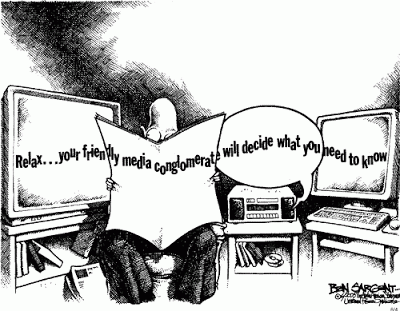
media conglomerate


There is a lot to talk about this advertisement. I think what is trying to say is that media is deciding everithing you need to know in an ironic sense using the word "Relax..." Like I had say before, whoever´s controlling media has a big influence and power in a country or in the world, because a lot of information that we acquire everiday comes from media (internet, television, radio). Imagine if a person has the power to achieve all media resources we will all finally be controlled by that person, following his personal interests. That´s why we should be aware of every information we recibe from any tipe of media, asking for resources.

Media Power on Society – Celebrity Influence on Youth Culture (class summary)

"The media occupies a unique position within our society. A collective term encompassing such things as newspapers, magazines, radio and television stations, the media plays an integral part in the shaping of our culture, while being outside it; it exists as a cog in the system, and also as an observer outside the system. It encourages and criticises, reports and contorts, informs and influences."

Power and Influence

Because we live in a society where reputation is important, and credibility is a sought-after attribute, the individual is forced to maintain an external image that is acceptable to those around them. In everyday life, people surrounding the individual are family, friends and colleagues from a place of employment or study. However, there are some individuals that are in the public eye; there are some in important positions; some making important decisions, and of course companies and corporations conducting business. For this set of entities, reputation and credibility assume far greater importance, as to let either slip may well result a loss of popularity, loss of position or power, or loss of market share, or some other financial loss. This is where the media has obtained the power it now has.
It is the judgement that the media exercises that is the critical issue. In our Western-style society it is unusual to be free from material generated by the media. Whether it be watching television, reading a newspaper, listening to the radio, even reading electronic mail, one is subjected to an array of “input” from a variety of sources. The penetration into our lives by the media leaves most of us open to the influences and pressures that the media choose to exert. It is an unusual individual that can disassociate themselves and make a balanced decision free from media-based bias.
3196650975_66c20da703
My reflection about what we saw in class is that I agree that media is a very powerful tool in society, and specially in youth society. In my circle of friends we communicate almost all day using social networks. Twitter, Facebook, Whatsapp, Blackberry Messenger, MySpace, etc are usual in almost all teenage lifes, we are all day connected to this pages and we form a lot of our opinions and get information by this social networks, that´s why it´s so important and at the same time is dangerous, whoever´s controlling this media networks can affect on our actions, opinions and interaction in life. Media nowadays in my opinion is one of the most powerful tools of the world.

The basics about Paper 1

  • Paper 1 asks students to produce a written commentary on one of two unseen texts within one and a half hour.
  • Pasages for analysis may be complete pieces of writing or extracts from larger works. There is also the possibility of commenting on a visual text or extract from a longer piece. Possible text-types for analysis include: advertisements, opinion columns, brochures, extracts from memoirs, or travel writing.
  • Each individual text is presented with two guiding questions.
  • The official Paper 1 counts for 25% of the final grade. It is assessed externally.
Here there are 8 tips for improving my writting skills on Paper 1:

  1. Clauses at the beginning of a sentence: good idea, but avoid really long ones.
    There is nothing more boring than a series of sentences that all start with the subject of the sentence:
    Instead of: "I train dogs. The animal shelter hires me. I do this every weekend."
    Try: "As part of my weekend job at the animal shelter, I train dogs."

    While clauses at the beginnings of sentences are great, you can have too much of a good thing. Avoid really long clauses at the beginning of a sentence:
    Instead of: "Every day, as I walk to work and pass the kiosk, where they sell those delicious chocolate bars, I stop to buy one."
    Try: "Every day on my way to work, I stop to buy one of those delicious chocolate bars that they sell at the kiosk."
     
  2. Avoid 'it' as the subject of a sentence.
    Sentences that start with 'it' or dummy subjects, such as 'there is...' or 'there are...', are quite weak.
    Instead of: "It is often the case that mobile phones end up on the lunch trays after the meal."
    Try: "Mobile phones often end up on the lunch trays after the meal."

    Sentences that start with 'there is..' or 'there are... often have a 'who' or 'which' that follow. These can be cleaned up as follows:
    Instead of: "There is this guy at school who always annoys me."
    Try: "This guy at school always annoys me."
     
  3. Use the right verb tense.
    This may come more naturally for native speakers of English. Nevertheless, many people make mistakes in the verb tense that they use. Be sure to know when to use each tense, such as the present simple, the present perfect, etc.
    Instead of: "I am attending this school since 2010."
    Try: "I have attended this school since 2010" (the present perfect).
     
  4. Use (relative) clauses.
    Using clauses in general is a good idea, as we saw in the first tip. Using relative clauses, which expand on ideas further (like this one), are also a good idea. Relative clauses make use of words such as 'which', 'who' and 'where'
    Instead of: "I have a new job. I enjoy it a lot."
    Try: "I have a new job, which I enjoy a lot."
     
  5. Watch out for wordy sentences.
    It is good to read and reread your own work. Often times during self-evaluation, you see sentences that are not clear or 'run on'. Wordy sentences can be cleaned up with punctuation and parallel constructions (Tip 7).
    Instead of: "If everyone in the building were to just clean up their own garbage and  if they  just sorted it properly then the recycle man wouldn't have to go through everything, then we wouldn't have to pay extra fees for this service."
    Try: "If everyone in the building disposed of his or her own waste in the proper recycle bins, then we would not have extra expenses."
     
  6. Never start a sentence with 'But'.
    Although you may see sentences that start with 'But' in other works, you should avoid starting sentences with it for academic purposes.
    Instead of: "The character displays a lot of courage. But she fails to save the day."
    Try: "Although the character displays a lot of courage, she fails to save the day."
     
  7. Use parallelisms.
    Parallelisms are sentences or phrases that contain parallel syntactical structures. These usually contain lists of noun phrases or clauses with similar structure. For example: "I decided not to (1) use PowerPoint, (2) read notecards or (3) memorize a script." Notice how ideas 1-3 all contain a verb and an object. They all line up nicely in parallel.
    Instead of: "I brushed the children's teeth and then I read a book to them. They climbed under the covers and I tucked them in."
    Try: "I brushed the children's teeth, read them a book and tucked them in."
     
  8. Use active verbs.
    In persuasive and academic writing and speaking, active verbs sound much stronger than passive verbs. Passive verb phrases use the verb 'to be' and the past participle of another verb. For example "The house was built by me." The active form of this phrase would be: "I built the house."
    Instead of: "The novel has been criticized by feminists."
    Try: "Feminists have criticized the novel"


Paper 1: Outline

I chose the text "Why Antigua and Barbuda?"

I will analyze some basic topics of the language and structure used:
- It´s a brochure.
- It uses formal language
- The audience has to be people who want to travel and spend their vacations on an island were they can party and have a lot of fun.
- The use of persuasive images of the place.
- The use of rethorical devices (repetitions).
- The purpose is to convince the audience to visit the island.
- In the content of the text it insists on beaches and also some other attractions.


FOA Planning guide

Class Concepts


  • Persuasive Language in Media
  • Ideas from different political speeches (Obama-Keneddy), different ads, and essay of Iris Breuer & Melanie Napthine with Rosemary O’Shea,etc.

Sources
http://www.insightpublications.com.au/pdf_preview/Persuasive-Language-in-Media-Texts-10-pages.pdfhttp://changingminds.org/techniques/language/persuasive/persuasive.htm http://www.managetrainlearn.com/page/an-appeal-from-Aristotle http://medialiteracyproject.org/language-persuasion http://www.famous-speeches-and-speech-topics.info/speech-topics/persuasive-speech.htm http://www.speechgems.com/persuaders.html http://www.famous-speeches-and-speech-topics.info/presidential-speeches/john-f-kennedy-speech-we-choose-to-go-to-the-moon.htm

  • Thesis: Language is not only superficial. When we read somethin we have to be aware that language in Media have many hidden message to convince or persuade people, with different techniques.
  • Media trying to persuade us is something that affect all of us nowadays, because of the world we are living in it. Persuasion is a very powerfull and frequent element.
TEXT
  • This investigation would help me to understand better and know some new techniques uses by the people and the Media, to persuade us.
Research
  • In this presentation we will present our point of view, supported with our analysis based on what we have learned.
  • The important elements of this presentation would be the verb 'to persuade', the techniques uses such us emotive language, the 'three rule', etc.
  • Iris Breuer & Melanie Napthine with Rosemary O’Shea, are the author that we extract the ideas from.
By: Me and my partner http://mweitzm.blogspot.com/

FOA Written reflection

Area to which the task is linked. (Please include the sub topic to which it is linked)
Persuasive language in media text.
Activity type: Oral presentation.

In the table below, candidates must list the source of all support materials that relate to the presentation. (You should also attach a properly formatted bibliography, as appropriate.)

Title of Work/Text
Author
Text Type
 Persuasive language in media texts. Iris Breuer and Melanie Napthine with Rosemary
O´Shea
 Informative text.
 "We choose to go to the moon"John Kennedy Political speech (persuasive) 
 Victory speech in Saint Carolina, Idaho.Barack Obama Political speech (persuasive)
"Safe a Life"
"Safe a life" company.
Advertisement
 "Will to win"Nike company. Advertisement 
 -------------- AxeAdvertisement 

Bibliography:

In the Further Oral Activity I learned and develop new skills to use language in life, because we saw a lot of videos and publicity spots that have to do with persuation, learning styles, registers, tones, figurative language, etc. I liked very much the "Victory speech" of Barack Obama, because I could learn from his personality a lot of language techniques that may be useful in the future for my career.

My purpuse on the FOA was to determine the techniques in oral/written language by watching and analizing a lot of publicity spots and speeches, and also a lot of investigation with many resources about the persuasive language themes. Finally we were able to establish a lot of techniques that we didn´t notice before, like "The rule of three" and the use of subliminal messages.

To conclude I have to say the I liked very much the topic of my FOA, because it was in straight relationship of the topics we were viewing in class, specially language. I had fun and learned a lot of politics and marketing that also were in relation with the topic of the work. My partner and I could develop all the objetives that we wanted before we started working.


viernes, 21 de junio de 2013

Written task: Idea planner


Idea Planner for Written Task 1 on Language and Mass Communication

Idea: Media biased in communists governments
Text type: Interview
Topic: How media is biased in a communist government?

Audience: People who have interest on politics or on how does a communist government works.

Why this text type is appropriate to topic: Because with an interview I can invent a local person of a communist country that gives a testimony of living in a communist system. This person will give the interview a sense of realism and awareness to the audience, so it will be more effective to call the audience attention.


viernes, 14 de junio de 2013

IB Programm: Paper 1

      This text is an online brochure about visiting Antigua & Barbuda, so we can say that its genre a non-fiction text, "the twin-island nation of Antigua & Barbuda, the largest and most developed tourist destination in the Leeward Islands chain", with this evidence I can prove that its a non-fiction text, because Antigua & Barbuda is a real country and the information of the quote is a real fact. It´s and informational and also a persuasive text, "Antigua & Barbuda is the larger of the two islands at about 108 square miles (...) Islanders claim their home boasts 365 beaches, and while the count is questionable, the beaches are beautiful", this quote stands as evidence that the text is informing its audience about the island and also using descriptive adjectives to convince the reader to visit the place, as "beautiful". The audience to whom the message is directed is the people who are planning to travel to some place and are searching places to visit on Internet websites, this people have to be people with a certain amount of money and also we have interests to have fun, "upscale resorts for the very rich to comfy hideaways  favored by sailors" " the atmosphere is pure fun and local bands play infectious dance music". This quotes describe the type of people for whom this message is directed.

     The content of this brochure  is a description of the twin-island of Antigua & Barbuda, "Antigua is the larger of the two islands at about 108 square miles (...) Barbuda, the smaller sister island, is wild, woolly and barely inhabitated". This quote proves that the content is very descriptive about the twin-islands. I think that the theme of this brochure, as it is an informative-persuasive text, would be located in the first paragraph.  The theme of the brochure would be: the best option for tourists vacation is to visit Antigua & Barbuda, "The twin-island nation of Antigua & Barbuda, the largest and most developed tourist destination in the Leeward Islands chain, has much to offer visitors of many stripes". This would be the theme of the brochure because all the further ideas of the text develop from the idea of proving that the twin-islands are the best place to visit for tourists.

     The language used in the brochure is formal, within some persuasive and also informative techniques, as the use of descriptive adjectives, giving information of mostly all the good things about the island (events, geography, places for tourism), leaving away the negative issues, "the beaches are beautiful", "winding roads of pineapple fields, with the desert-like conditions rounding out the scenery". This quotations prove the persuasive and also informational techniques of the language used in the brochure and also some other aspects of the language in the text. The use of day colors and also the use of images about the place in a well-planned structure of the brochure. This aspects are also persuasive for the audience, to convince about visiting the place by putting nice images and powerful colors to call the attention. The text starts with a rethorical question for people for people to get interested in why they should visit Antigua & Barbuda , also the use of repetition with the word "beaches", used to describe the principal attraction of the twin-island.

    In conclusion, we can say that this brochure has a lot of techniques and characteristics to persuade the audience to travel to Antigua & Barbuda, like the use of images and colors, the argumental aspects on the text and also the use of rethorical figures expressed. The theme of the brochure is well developed among the text, because it uses a lot of arguments to convince the selective audience to visit the place, by refering to informational facts and also persuasive adjectives.