Due to war-time censorship and the desire to keep up the morale of the nation, the full extent of the unfolding "disaster" around Dunkirk was not publicised. However, the grave plight of the troops led King George VI to call for an unprecedented week of prayer. Throughout the country, people prayed on 26 May for a miraculous delivery. The Archbishop of Canterbury led prayers "for our soldiers in dire peril in France". Similar prayers were offered in synagogues and churches throughout Britain that day, confirming the public suspicion of the desperate plight of the troops.
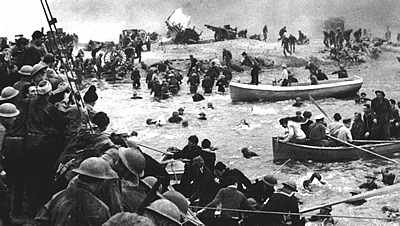 Initial plans called for the recovery of 30,000 men from the British Expeditionary Force (BEF) within two days, at which time it was expected that German troops would be able to block further evacuation. Only 25,000 men escaped during this period, including 7,000 on the first day. Ten additional destroyers joined the rescue effort on 26 May and attempted rescue operations in the early morning, but were unable to closely approach the beaches, although several thousand were rescued. However, the pace of evacuation from the shrinking Dunkirk pocket steadily increased.
On 29 May 47,000 British troops were rescued in spite of the first heavy aerial attack by the Luftwaffe in the evening. The next day, an additional 54,000 men were embarked, including the first French soldiers. 68,000 men and the commander of the BEF—Lord Gort—evacuated on 31 May. A further 64,000 Allied soldiers departed on 1 June, before the increasing air attacks prevented further daylight evacuation. The British rearguard left the night of 2 June, along with 60,000 French soldiers. An additional 26,000 French troops were retrieved the following night before the operation finally ended.
Two French divisions remained behind to protect the evacuation. Though they halted the German advance, they were soon captured. The remainder of the rearguard, largely French, surrendered on 3 June 1940. The next day, the BBC reported, "Major-General Harold Alexander [the commander of the rearguard] inspected the shores of Dunkirk from a motorboat this morning to make sure no-one was left behind before boarding the last ship back to Britain."
| Date | Troops evacuated from beaches | Troops evacuated from Dunkirk Harbour | Total |
|---|---|---|---|
| 27 May | – | 7,669 | 7,669 |
| 28 May | 5,930 | 11,874 | 17,804 |
| 29 May | 13,752 | 33,558 | 47,310 |
| 30 May | 29,512 | 24,311 | 53,823 |
| 31 May | 22,942 | 45,072 | 68,014 |
| 1 June | 17,348 | 47,081 | 64,429 |
| 2 June | 6,695 | 19,561 | 26,256 |
| 3 June | 1,870 | 24,876 | 26,746 |
| 4 June | 622 | 25,553 | 26,175 |
| Totals | 98,780 | 239,446 | 338,226 |

No hay comentarios:
Publicar un comentario